augenmerk AI Analytics

The product

What the AI passes on about your brand. And how you influence it.

Every week augenmerk measures whether and how ChatGPT, Gemini, Claude, Grok, Perplexity and Google mention your brand, compared with your competitors. This page shows what you learn from it, what you do with it and how it connects to your website. All screenshots come from real measurements; the application is available in English, the screenshots show the German interface.

What you get

What you learn about your AI visibility. Six answers a score cannot give.

A visibility score tells you how often your brand appears in AI answers. It does not tell you why, whether the number is reliable, which system produces it, where your competitors stand and what to do now. augenmerk answers these six questions one by one, and each answer leads to its own measure.

What the AI says

Model knowledge and live search, measured separately.

An AI system can know your brand from training and still fail to find it when it searches the web live. A combined score hides that difference. augenmerk reports presence per channel separately: what the model knows on its own and what it finds in the sources it draws on when searching, for your brand and every product line. Every competitor sits next to it with the same metrics.

Two diagnoses instead of one number, and a measure for each.
Overview for benzin.jetzt: channel contrast with model knowledge 0 %, live search 7 %, Google answer box 5 %, trend and presence next to it
The AI does not know benzin.jetzt, but it finds it. Model knowledge 0 %, live search 7 %: two numbers, two measures. A single total would have swallowed both.
How reliable it is

Measured weekly. All real changes at a glance.

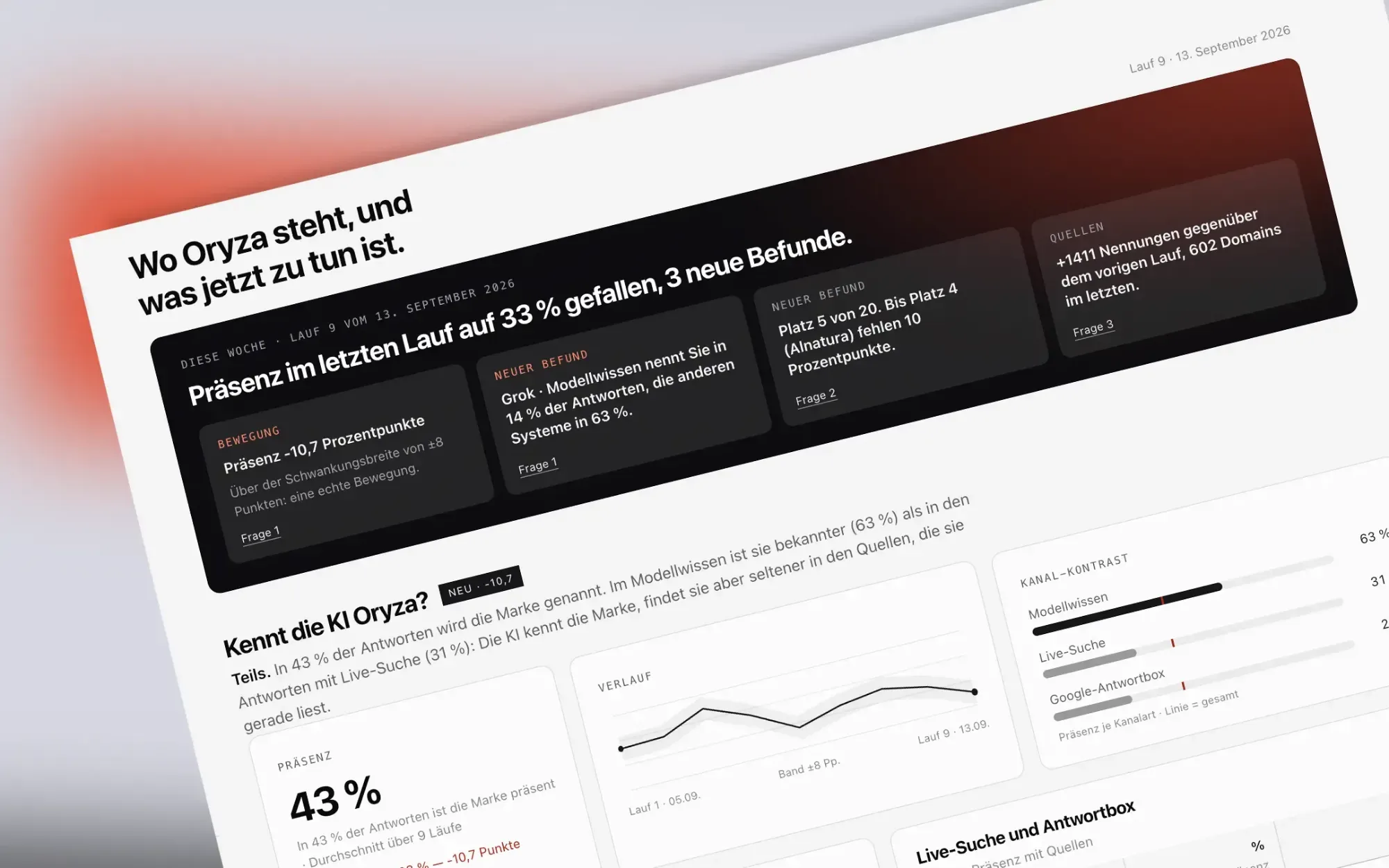
The same question gets two different answers on two days. So augenmerk measures afresh every week and calculates presence across all runs: in the picture Oryza stands at 43 %, the average of nine runs. A band of ±8 points, the noise band, wraps the trend. If a run falls outside the band, as here with −10.7 points, the overview reports a movement and puts the new findings next to it. If it stays inside, it stays quiet.

You react to real changes, not to daily noise. The more questions, the narrower the band: ±10 points with eight questions, around ±5 with 32.
Overview for Oryza: presence dropped to 33 % in the last run, −10.7 percentage points, outside the ±8 noise band
−10.7 points against a ±8 noise band: that is movement, not noise. That is exactly how the overview reports it. If the value were inside the band, it would read “chance between two runs”.
What follows

Every finding with reason, action and success metric.

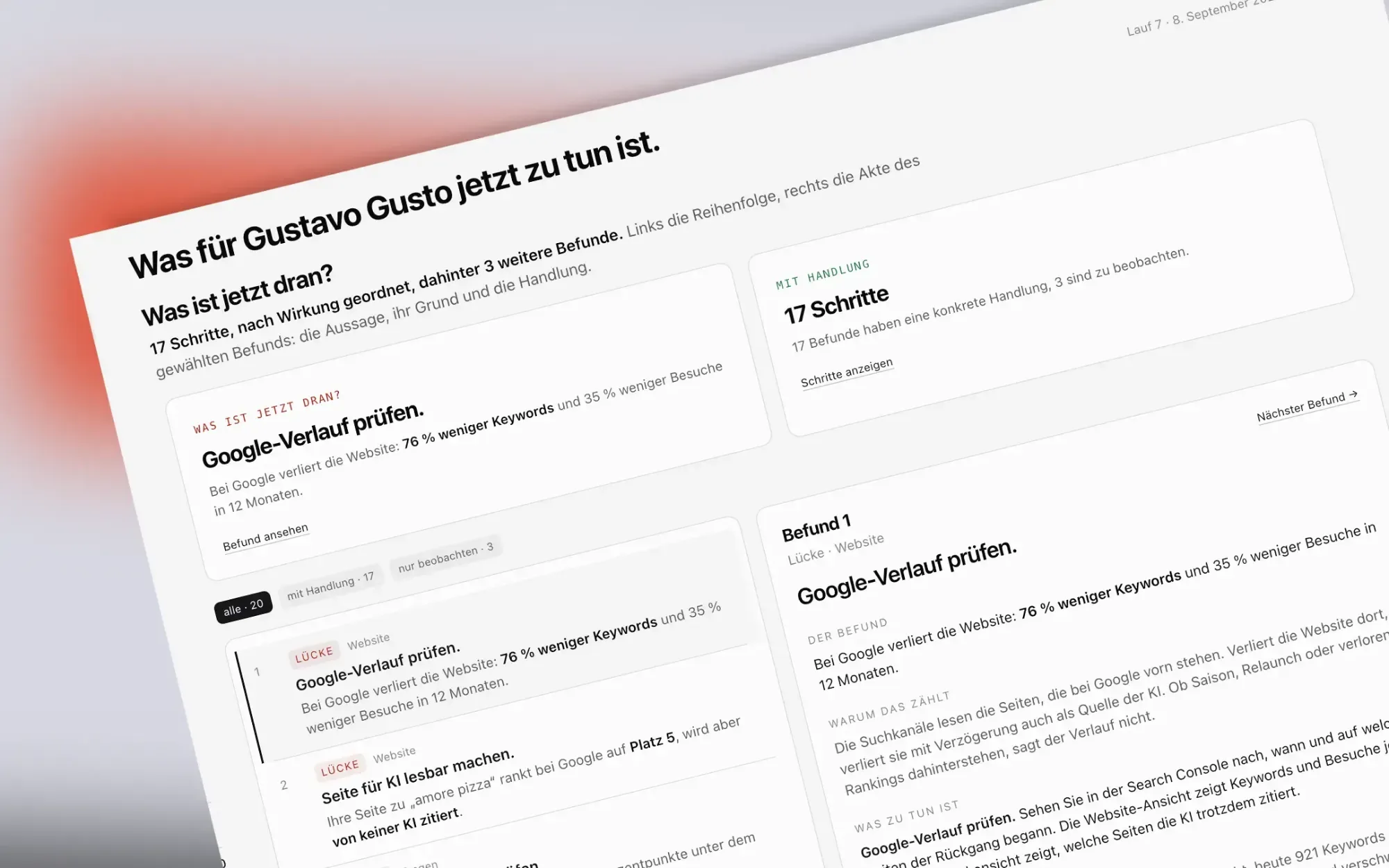
Every run produces findings, ordered by impact: what stops the AI from reading comes before what is missing. For every finding you see the reason, the recommendation and the metric that shows success. A finding is done when the following runs show the effect, not when someone ticks it off.

A short summary for your management every week, the numbers one click deeper. Your team knows what it is working on and sees in the next run whether it worked.
Next steps: list of findings by impact, the file with finding, reason, action and effect on the right
The first finding is the most effective. Reason, action and the number that shows success sit next to it. It is done when the next run measures it.
Who says it

All systems, every run. And which one tells a different story.

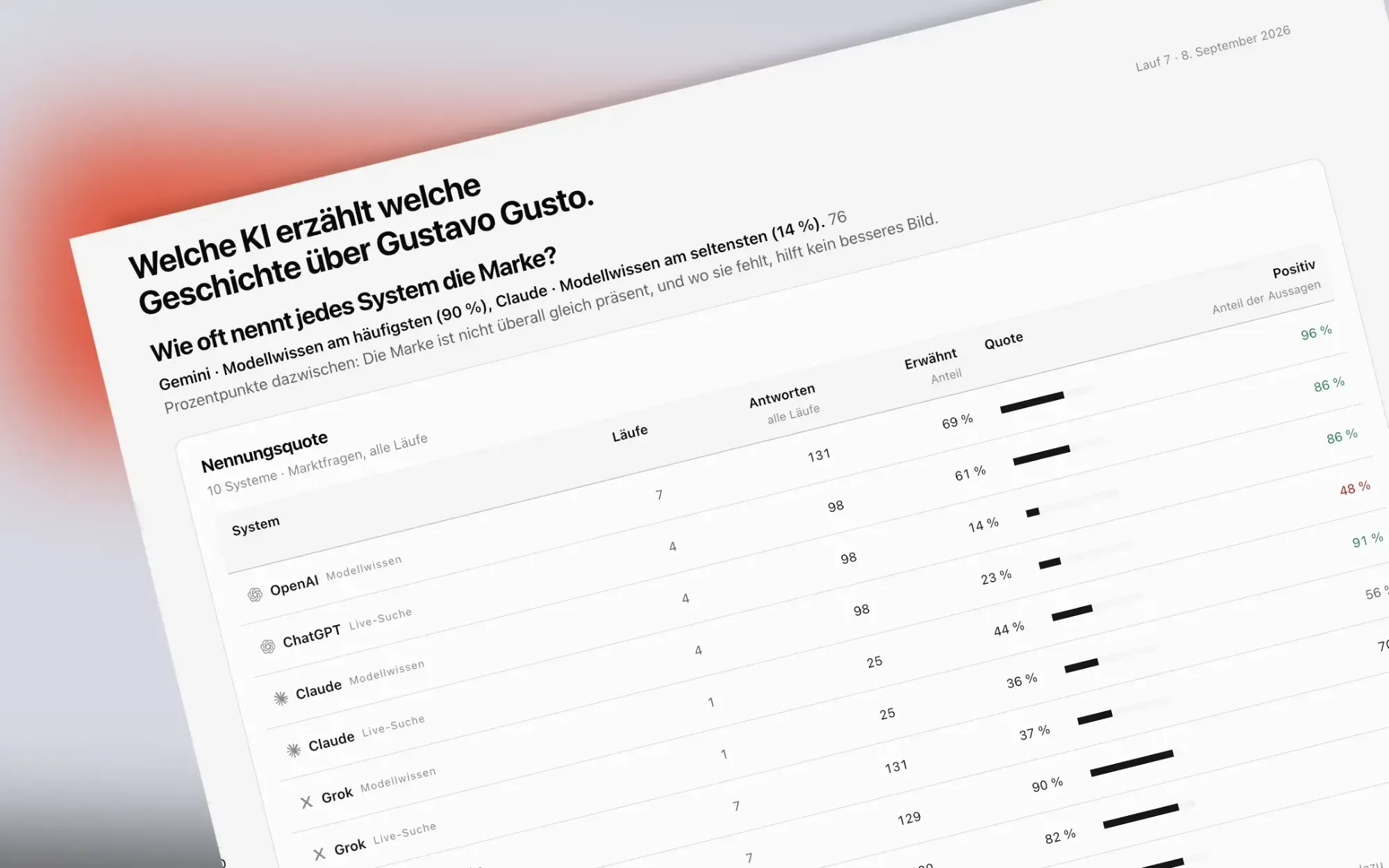
augenmerk evaluates all ten channels: ChatGPT, Gemini, Claude and Grok, each from model knowledge and with live search, plus Perplexity and Google’s answer box. No overall score: per system you see how often the brand is mentioned, in what tone and with which topics. So it stands out when one deviates. Plus the cross-check: “What are the downsides of …?”, “Who is … not suitable for?”, “Is … worth the price?”: the questions buyers use to be talked out of it. Most tools measure whether you are recommended. augenmerk also measures whether the AI advises against you.

You see not only what the AI systems say but which system says what, and whether one of them steers buyers away from you.
Systems: mention rate per AI system, from Gemini model knowledge at 90 % to Claude model knowledge at 14 %
Gemini knows Gustavo Gusto in 90 % of answers, Claude in 14 %. Anyone looking at a single total would treat both systems the same.
From every angle

The same analysis from each competitor’s point of view. And per product line.

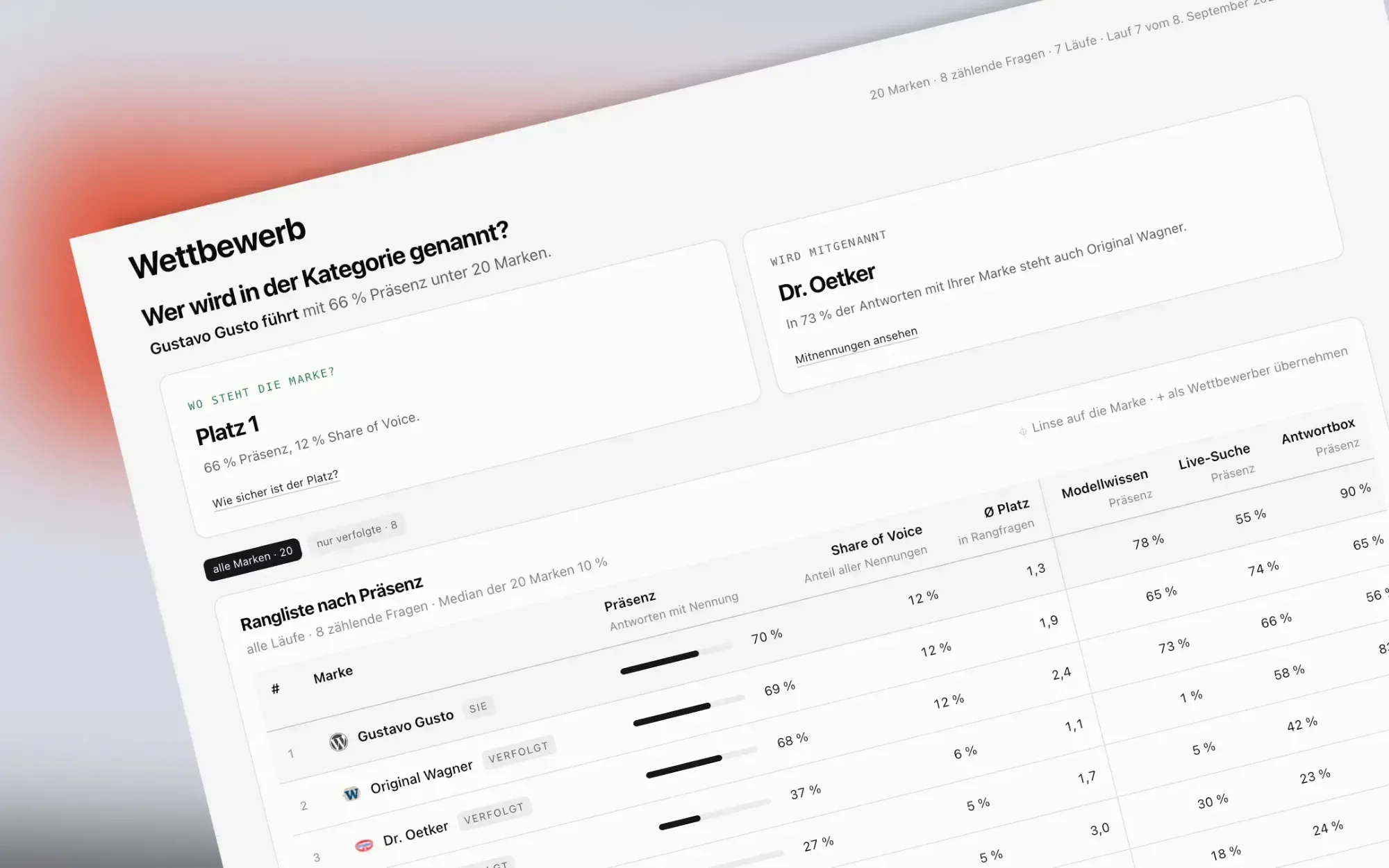
Every question measures all brands in a market at once. So the entire analysis (presence, topics, sources, findings) can be switched to a competitor with one click: from the same answers you see what they have and you do not. Segments report a separate presence for each product line, so a strong range does not hide the weakness of another.

Competitor analysis without a second project and without a second invoice.
Competitors: ranking by presence with share of voice, position and presence per channel type for every brand
20 brands from the same answers. One click on ⌖ turns any of them into its own point of view: competitor analysis without a second project and without a second invoice.
AI assistant

Ask questions about your results. The assistant answers with evidence.

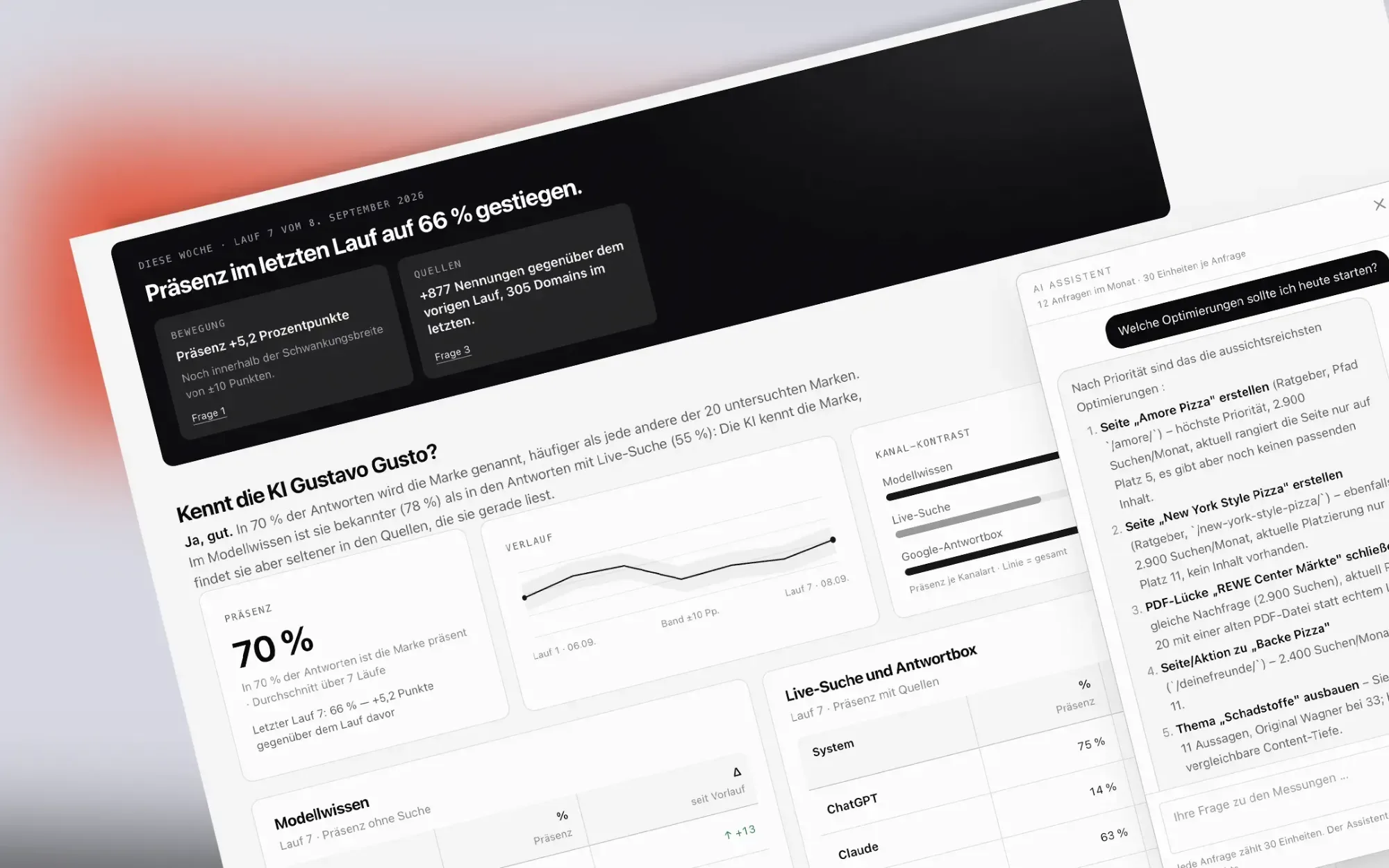
The assistant knows your project: it reads the same data as the views and knows how augenmerk works from the documentation. It explains every view, answers questions such as “Where are the gaps in our portfolio?” or “Which page do I revise first?” and points to the view the answer comes from. What it cannot derive from your measurements, it says so. It does not guess and does not start measurements.

Anyone who cannot place a number asks and gets an answer with evidence. No training, no ticket. Up to 50 requests a month in Starter, 150 in Pro.
AI assistant next to the overview: question about today’s optimisations, answer as a list by priority with demand, position and path
“Which optimisations should I start today?” Five answers with search demand, Google position and the affected page, each from your own measurements, none from gut feeling.

Where SEO and GEO diverge

Pages that rank on Google but are never cited by an AI.

For every domain augenmerk reads which pages rank on Google for which queries, and sets beside them which pages the AI systems use as sources. The two rarely match: pages with demand that no AI cites are the first work list for your content team. The website view also checks whether AI crawlers can access your content at all.

The bridge

See which existing pages to improve first.

The gap view sets each page’s Google position and demand next to the number of AI answers that cite it. At the top are the pages with the widest gap: they have demand and substance but no AI cites them. The website check shows what hinders access: blocked AI crawlers, missing files, slow loading.

Improve the content that already has search demand.
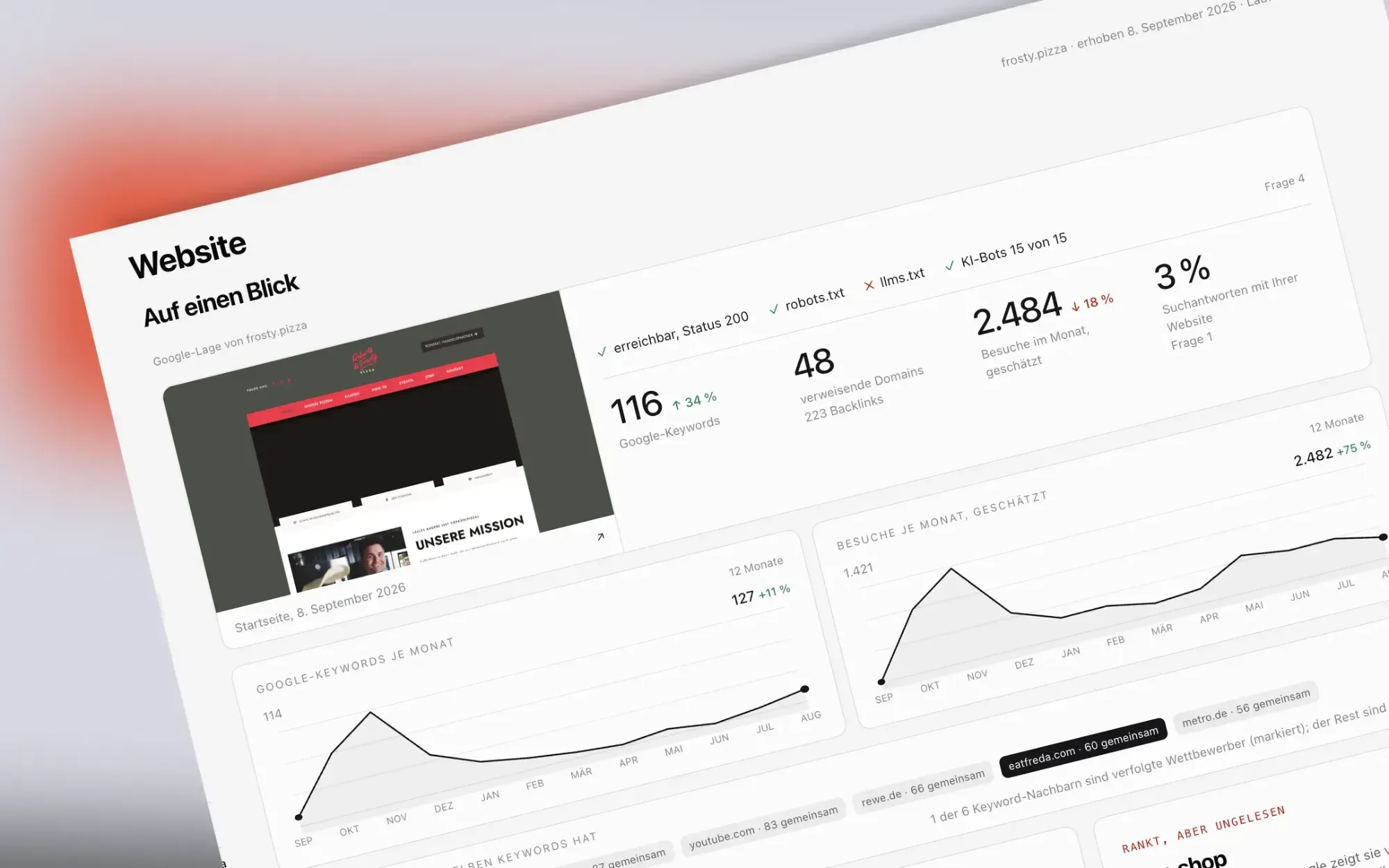
Website view: Google keywords and visits over time, AI access, keyword neighbours and the card “Ranks, but unread”
Ranks, but unread. Google shows the page up front, no AI draws on it as a source. Such pages are the first work list because demand and substance are already there.

New · Beta

OpenAI Ads. The gap becomes an ad.

Ads in ChatGPT appear below the answer when the conversation matches the offer, served by context rather than keywords. augenmerk knows from the measurement where that context lies: in the questions where ChatGPT does not mention your brand, and in the conversations where the AI discusses you critically. That is exactly what the campaign plan is built from.

The campaign plan

Ad groups, context hints and copy, built from your measurement data.

The “AI ads” view orders your questions by gap and Google demand and builds ad groups by need: context hints from the questions, ad copy from the measured strengths, landing pages from the pages Google and the AI already know for these questions, plus a bid recommendation. For objections such as a test verdict or criticism of fees, it produces no appeasement but a factual answer, and only with a page that backs it up. If the page is missing, the plan says so instead of pointing to the homepage.

We create the plan in your OpenAI ads account, paused. You review and switch it on; budget and billing stay with OpenAI and with you. Beta: included in Pro, available in Starter for €29 a month.

Join the OpenAI Ads beta

Which account is cheapest for travelling abroad?

For travel, providers without foreign-currency fees such as Wise, N26 or DKB are recommended. Watch the withdrawal limits and exchange rate …

RRevolutAd
Pay abroad without a markup Exchange in 30+ currencies at the mid-market rate on weekdays; limits per plan on the page. revolut.com/de-DE/travel
The gap: asked about a travel account, ChatGPT names Wise, N26 and DKB, and Revolut in none of four runs, although the brand stands for exactly that. The ad targets this question and leads to the page that backs up the advantage: exchange rate, currencies, limits per plan.

What we measure, analyse and prepare for you

Clear in the statement. Complete in the data.

Every view answers one question in a sentence. Underneath lies everything a specialist team expects. Here are the metrics augenmerk collects and prepares per project.

  • PresenceShare of AI answers that mention your brand, per question, per channel, per run.
  • PositionWhere the brand stands in ranking answers, averaged across all ranking questions.
  • Share of voiceYour share of all brand mentions in the market, against every competitor.
  • Channel contrastModel knowledge vs. live search vs. Google answer box: whether the AI does not know you or just cannot find you.
  • Presence per AI systemThe same metric for ChatGPT, Claude, Gemini, Grok, Perplexity and Google individually.
  • Noise bandHow much the same questions scatter between two runs, and from when a change counts as movement.
  • TrendEvery metric across all runs, with weekly status and marked movements.
  • SentimentShare of positive, neutral and critical statements about the brand, with quote.
  • Brand imageAttributes the AI associates with the brand: praise, criticism and prominence per attribute.
  • ObjectionsWhat the AI holds against the brand, verbatim, with channel and date.
  • Purchase cross-checkWhat the AI answers when someone checks your brand before buying: downsides, “not for whom”, value for money, with source.
  • TopicsWhich topics the AI associates with your brand and with every competitor, as a matrix.
  • SourcesThe domains and pages the AI reads from: mentioned or cited, per channel.
  • Citation rate of your websiteHow often your pages appear as a source in answers with live search.
  • PassagesEvery mention with the verbatim passage in the original answer, checked character by character.
  • The AI’s search queriesWhat Gemini, Claude and Grok actually search for before they answer.
  • SegmentsPresence per product line, so a strong range does not hide a weak one.
  • Competitor lensAll metrics from each competitor’s point of view, from the same answers.
  • Google visibility of the websiteRanking pages, queries and search volume per domain, next to the AI citations.
  • Gap viewPages that rank on Google but are never cited by an AI: your work list.
  • AI accessrobots.txt, llms.txt and 35 AI crawlers: whether the systems are allowed to read your content at all.
  • Load time and techLighthouse scores of the homepage as part of the website finding.
  • Findings and next stepsPrioritised files with reason, action and the metric that shows the effect.
  • Content ideasWhich pages or texts would close gaps, with origin, format and influence.
  • Raw answersEvery AI answer stored in full and readable: the basis for everything above.

Does the AI know your brand? You’ll know within the hour.

Free trial with ten questions on four channels, or straight to the plan that fits you. Cancel monthly, no setup, no agency needed.

Try for free See plans